The Plasma Module is tailor-made to model and simulate low-temperature plasma sources and systems. Engineers and scientists use it to gain insight into the physics of discharges and gauge the performance of existing or potential designs. The module can perform analysis in all space dimensions – 1D, 2D, and 3D. Plasma systems are, by their very nature, complicated systems with a high degree of nonlinearity. Small changes to the electrical input or plasma chemistry can result in significant changes in the discharge characteristics.
Low-temperature plasmas represent the amalgamation of fluid mechanics, reaction engineering, physical kinetics, heat transfer, mass transfer, and electromagnetics – a significant multiphysics system, in other words. The Plasma Module is a specialised tool for modelling non-equilibrium discharges, which occur in a wide range of engineering disciplines. The Plasma Module consists of a suite of physics interfaces that allow arbitrary systems to be modelled. These support the modelling of phenomena such as: direct current discharges, inductively-coupled plasmas, and microwave plasmas. A set of documented example models, with step-by-step descriptions of the modelling process, along with a user’s guide accompany the Plasma Module.
A square coil is placed on top of a dielectric window and is electrically excited, while a plasma is formed in an argon-filled chamber beneath. The plasma is sustained via electromagnetic induction where power is transferred from the electromagnetic fields to the electrons.
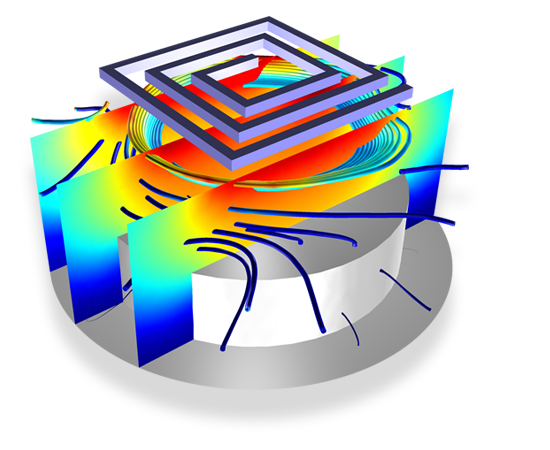
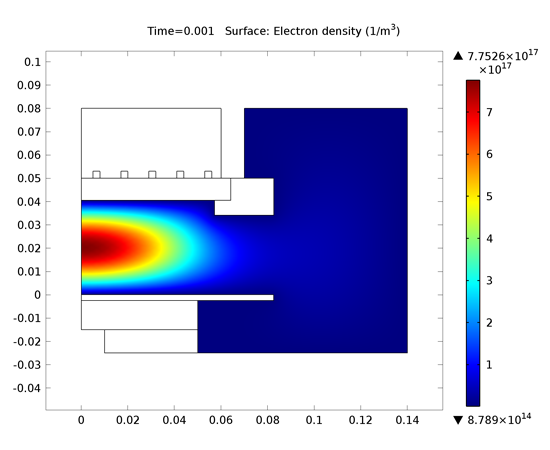
Inductively coupled plasmas (ICP) were first used in the 1960s as thermal plasmas in coating equipment. These devices operated at pressures on the order of 0.1 atm and produced gas temperatures on the order of 10,000 K. In the 1990s, ICP became popular in the film processing industry as a way of fabricating large semiconductor wafers. These plasmas operated in the low-pressure regime, from 0.002-1 torr, and as a consequence, the gas temperature remains close to room temperature. Low-pressure ICPs are attractive because they provide a relatively uniform plasma density over a large volume. The plasma density is also high, around 1018 1/m3, which results in a significant ion flux to the surface of the wafer. Faraday shields are often added to reduce the effect of capacitive coupling between the plasma and the driving coil. The Inductively Coupled Plasma interface automatically sets up the complicated coupling between the electrons and the high frequency electromagnetic fields that are present in this type of plasma. The Inductively Coupled Plasma interface requires both the Plasma Module and the AC/DC Module.
A specialised physics interface is available for modelling direct current (DC) discharges, which are sustained through secondary electron emission at the cathode due to ion bombardment. The interface allows for model inputs and contains the underlying equations and conditions for modelling this phenomenon. The electrons ejected from the cathode are accelerated through the cathode fall region into the bulk of the plasma. They may acquire enough energy to ionise the background gas, creating a new electron-ion pair. The electron makes its way to the anode, whereas the ion will migrate to the cathode where it may create a new secondary electron. It is not possible to sustain a DC discharge without including secondary electron emission.
You can use the Microwave Plasma interface to model wave heated discharges, which are sustained when electrons can gain enough energy from an electromagnetic wave as it penetrates the plasma. The physics of a microwave plasma are quite different depending on whether the TE mode (out-of-plane electric field) or the TM mode (in-plane electric field) is propagating. In neither case is it possible for the electromagnetic wave to penetrate into regions of the plasma where the electron density exceeds the critical electron density (around 7.6x10¹⁶ 1/m3 for argon at 2.45 GHz). The pressure range for microwave plasmas is very broad. For electron cyclotron resonance (ECR) plasmas, the pressure can be on the order of 1 Pa or less. For non-ECR plasmas, the pressure typically ranges from 100 Pa up to atmospheric pressure. The power can range from a few watts all the way up to several kilowatts. Microwave plasmas are popular thanks to the cheap availability of microwave power. The Microwave Plasma interface requires both the Plasma Module and the RF Module.
To facilitate your modelling of plasma processes, a new Global diffusion model now enables you to perform initial analyses of your processes, before optimising them with more accurate modelling. Global modelling reduces the degrees of freedom for your models through applying ordinary differential equations to your plasma model. This allows complex reaction chemistries to be tested and verified before running space-dependent models, while the reactor geometry, surface chemistry, and feed streams are all still taken into account.
Note that not all file formats are supported on all operative systems, for details see System Requirements
 Tel: +61 (03) 6224 8690Email: info@technic.com.auConnect on LinkedInGet Your Free Trial
Copyright © 2021 Technic Pty Ltd. All Rights Reserved. See our Privacy Policy. Site protected by reCAPTCHA - Privacy | Terms. Website by Gloo.