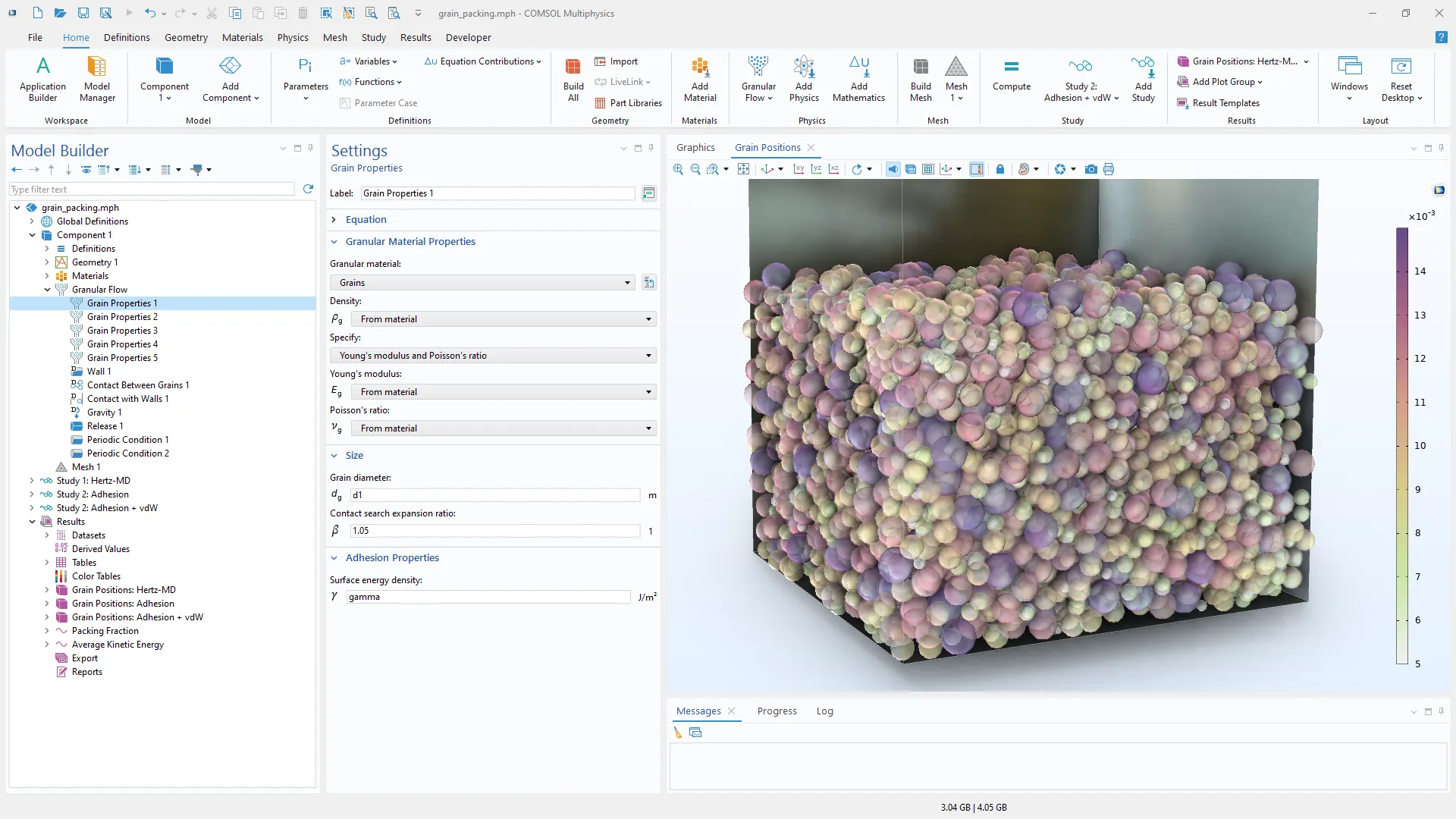
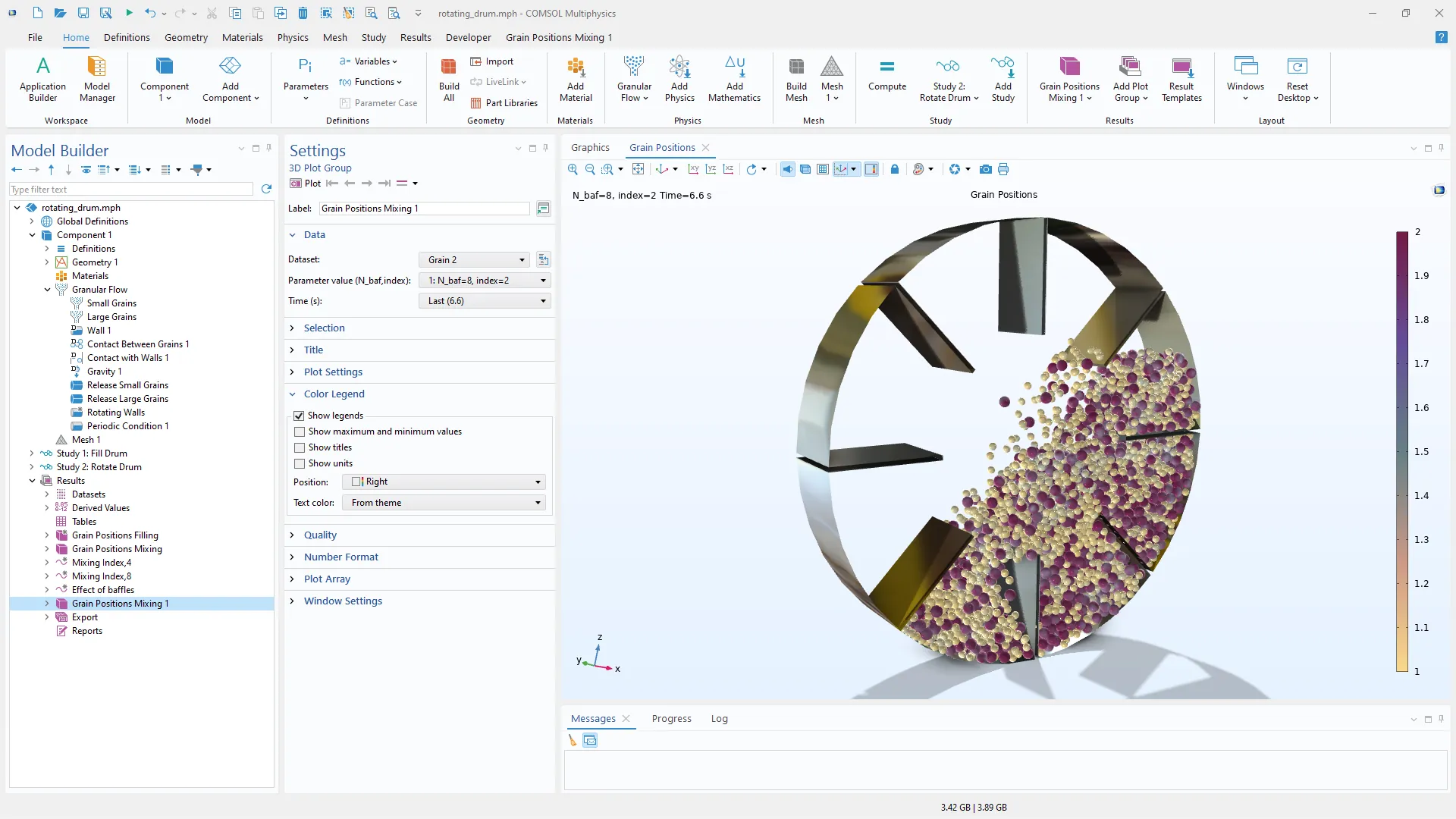
Granular Flow - particle interactions with differing sizes and interactions.

The Granular Flow Module is based on the discrete element method (DEM), a numerical technique for simulating granular flow by computing the motion of individual particles, or grains, over time. Unlike continuum-based methods, the DEM resolves each grain as a discrete entity with translational and rotational degrees of freedom. Their motion is governed by Newton’s laws, with forces arising from gravity, collisions with other grains, and interactions with surrounding boundaries.

The grains may represent powders, pellets, or bulk solids such as rocks, seeds, or tablets. Depending on the system, a variety of physical effects can be accounted for — including elastic and viscoelastic contact forces, adhesion, rotational resistance, and even heat transfer between grains and walls — using functionality included in the module. Grains are modeled as soft particles that deform upon contact, and their trajectories are updated for each time step, accounting for grain–grain and grain–wall collisions, as well as external forces, in order to predict the bulk motion of the system.

It is also possible to define the initial release conditions, velocities, and spatial arrangements of grains, as well as specify what happens when they interact with walls or leave the simulation domain.

Features and Functionality in the Granular Flow Module

The Granular Flow Module can simulate bulk particle behavior across a range of granular applications.
Grain Properties and Species
Particle Release and Inlet Features
Collision and Contact Models
Wall and Boundary Interactions
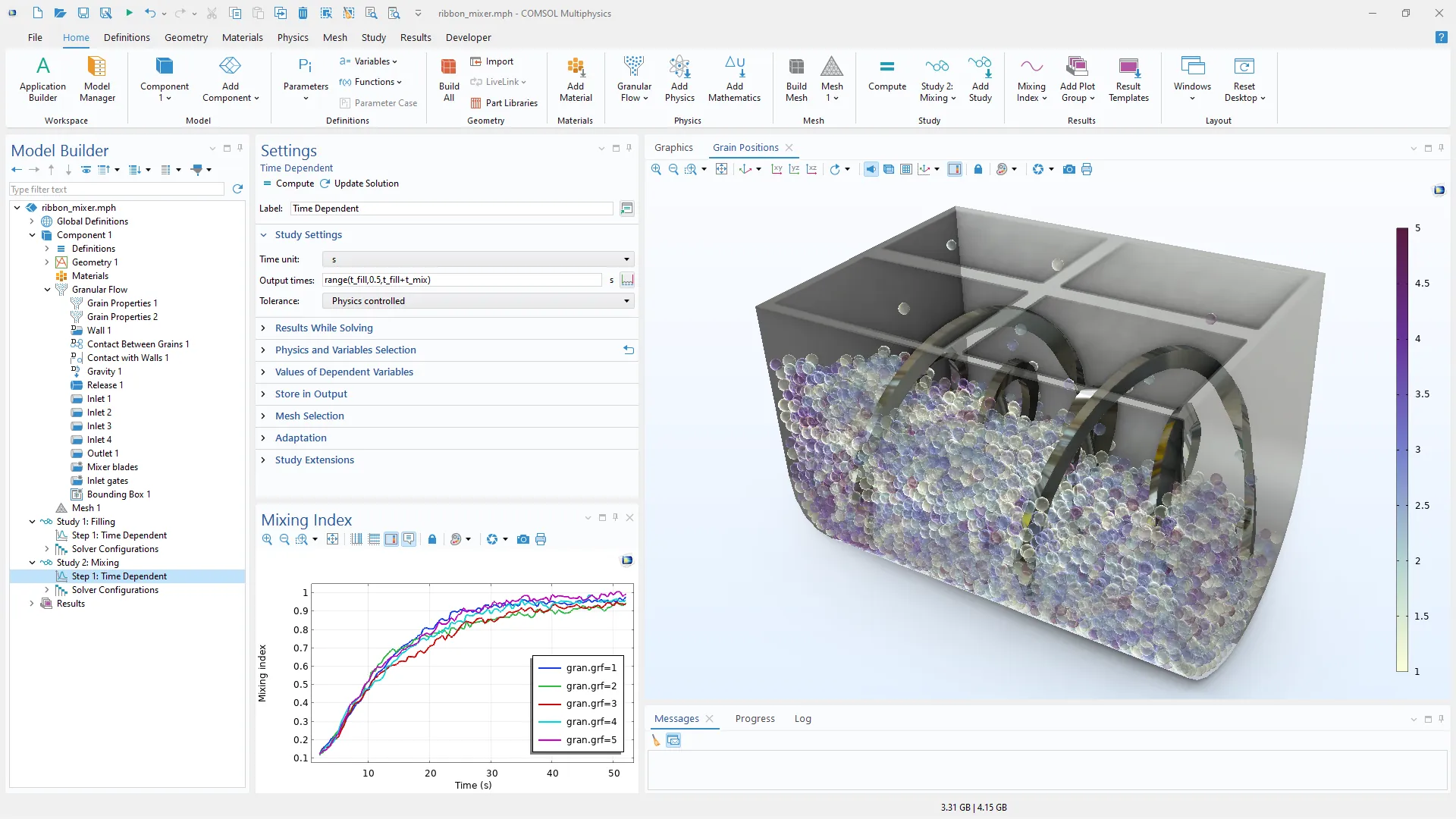
Mixing, Segregation, and Packing Analysis
Heat Transfer Between Grains and Walls
With the Granular Flow Module, it is possible to specify grain size, density, and stiffness and coefficients of restitution and friction, as well as introduce rolling resistance or adhesive forces for fine powders. Grain shape is treated as spherical in 3D and cylindrical in 2D, with translational and rotational degrees of freedom resolved at each time step. Multiple grain types can be defined in the same model, either as distinct species or drawn from size distributions, making it possible to capture segregation and mixing effects in polydisperse systems. Thermal properties such as specific heat capacity and conductivity can also be specified when including heat transfer.
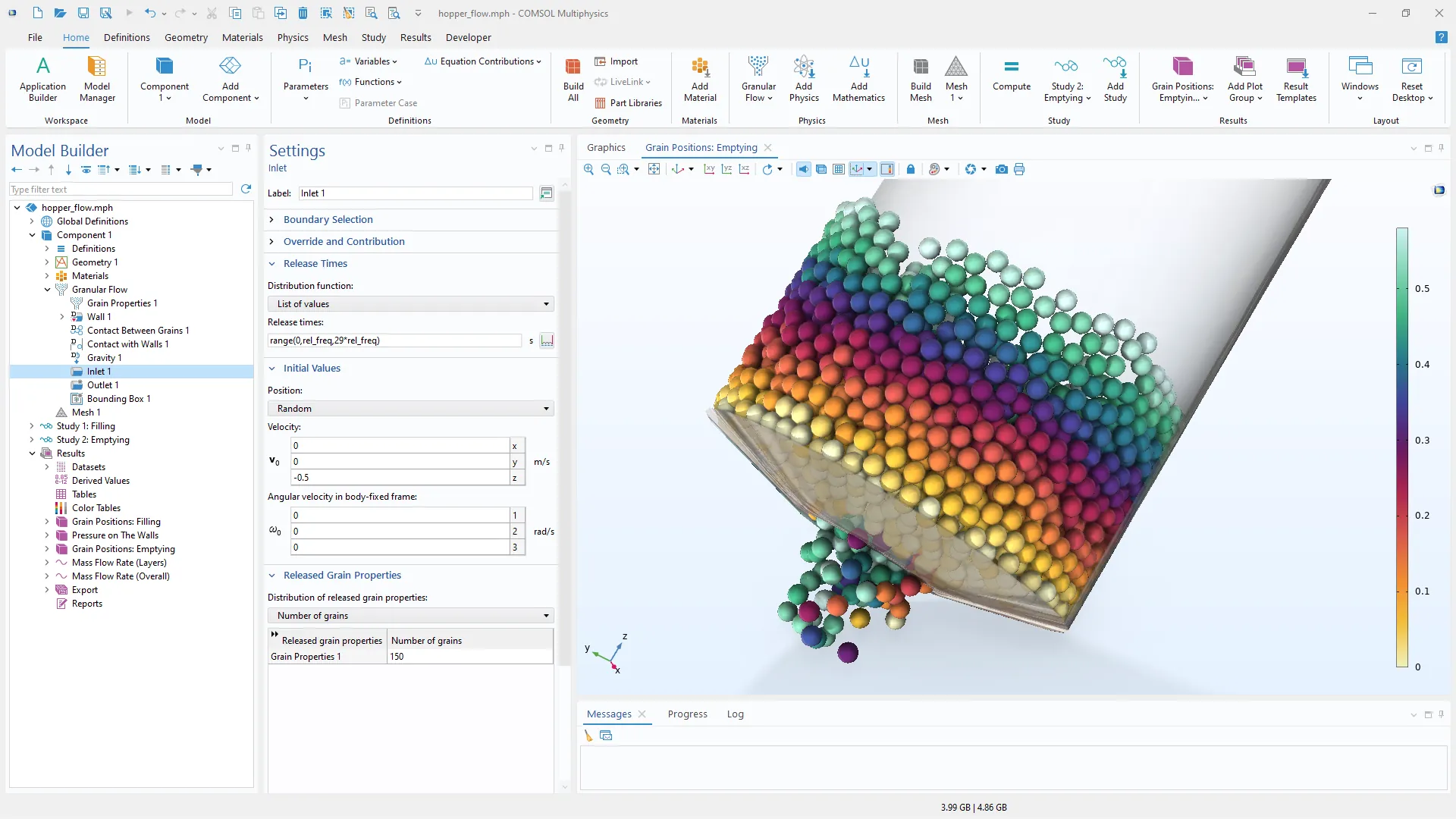
Grains can be introduced from surfaces or volumes, with full control over their initial positions, velocities, and release rates. In addition to monodisperse cases, grains can be sampled from defined distributions of material properties and sizes or their initial conditions. Both continuous inflows and batch releases can be simulated, and multiple release features can be combined to represent different material streams. Random number generators ensure variability in position, velocity, or size, with options for reproducibility using fixed seeds. These options make it possible to replicate realistic feeding conditions in silos, hoppers, mixers, and conveyors.
The module provides detailed control over how grains interact, with the option to choose between linear elastic, Hertz–Mindlin–Deresiewicz (Hertz–MD), or Hertz–MD with adhesion models. Noncontact forces such as van der Waals interactions can be added to capture long-range cohesion. Rotational resistance can be modeled using constant or velocity-dependent torque options. For both grain–grain and grain–wall collisions, it is possible to customize restitution, friction, and damping coefficients. This flexibility enables customized contact behavior for different material types, from free-flowing pellets to cohesive powders.
When particles collide with walls or leave a domain, their behavior can be customized: They can be allowed to pass through walls or completely removed via outlet conditions. Separate restitution and friction coefficients can be set for walls, and moving boundaries such as rotating drums, ribbon mixers, or vibrating sieves can also be modeled. Wall contact properties can even be defined per grain–wall pair, enabling simulations of heterogeneous systems with different wall materials or surface treatments.

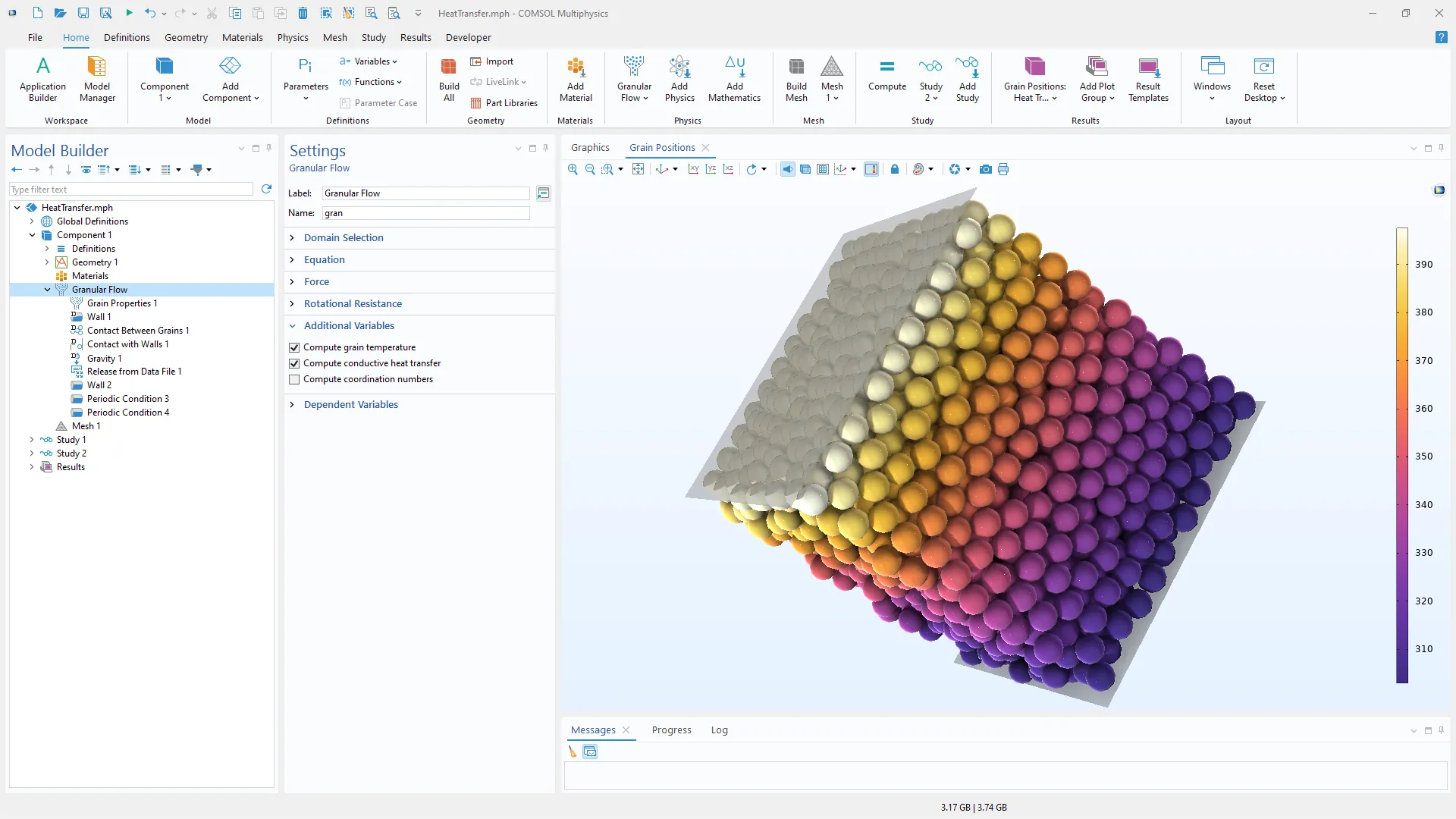
In addition to mechanical interactions, the module supports heat transfer modeling between grains and surrounding walls or external fields. Grain temperature is computed as an additional variable, assuming uniform temperature within each grain. Heat exchange includes conduction across contacts, convection with surrounding media, and external heat sources. Validity can be assessed using the Biot number, ensuring the assumption of uniform grain temperature holds for small, conductive particles. These capabilities enable studies of temperature-dependent processes such as powder spreading in additive manufacturing or thermal treatment of bulk solids.

Simulate the Heat Exchange between differing sized particles and walls to analyse the temperature dependant granular particle process.

Want to know more?

I Want To Know More Form
(COMSOL®, COMSOL Multiphysics®, Capture the Concept, COMSOL Desktop®) are registered trademarks of COMSOL AB, LiveLink™ is an unregistered trademark of COMSOL AB, ACIS and SAT are registered trademarks of Spatial Corporation. AutoCAD, AutoCAD Inventor and Inventor are registered trademarks or trademarks of Autodesk, Inc., and/or its subsidiaries and/or affiliates in the USA and/or other countries. CATIA is a registered trademark of Dassault Systèmes or its subsidiaries in the US and/or other countries. Microsoft, Excel and Windows are registered trademarks or trademarks of Microsoft Corporation in the United States and/or other countries. Parasolid and Solid Edge are trademarks or registered trademarks of Siemens Product Lifecycle Management Software Inc. or its subsidiaries in the United States and in other countries. SolidWorks is a registered trademark of Dassault Systèmes SolidWorks Corporation. Creo and Pro/ENGINEER are trademarks or registered trademarks of PTC Inc. or its subsidiaries in the U.S. and in other countries. MATLAB is a registered trademark of The MathWorks, Inc. Amazon Web Services, the “Powered by Amazon Web Services” logo, Amazon EC2 and Amazon Elastic Compute Cloud are trademarks of Amazon.com, Inc. or its affiliates in the United States and/or other countries. Mac and Macintosh are trademarks of Apple Inc., registered in the U.S. and other countries. Linux is a registered trademark of Linus Torvalds. Red Hat is a registered trademark of Red Hat, Inc. in the U.S. and other countries. Neither COMSOL nor any COMSOL products are affiliated with, endorsed by, sponsored by, or supported by any of these other trademark owners. Other product names, brand names or logos are trademarks or registered trademarks of their respective holders.