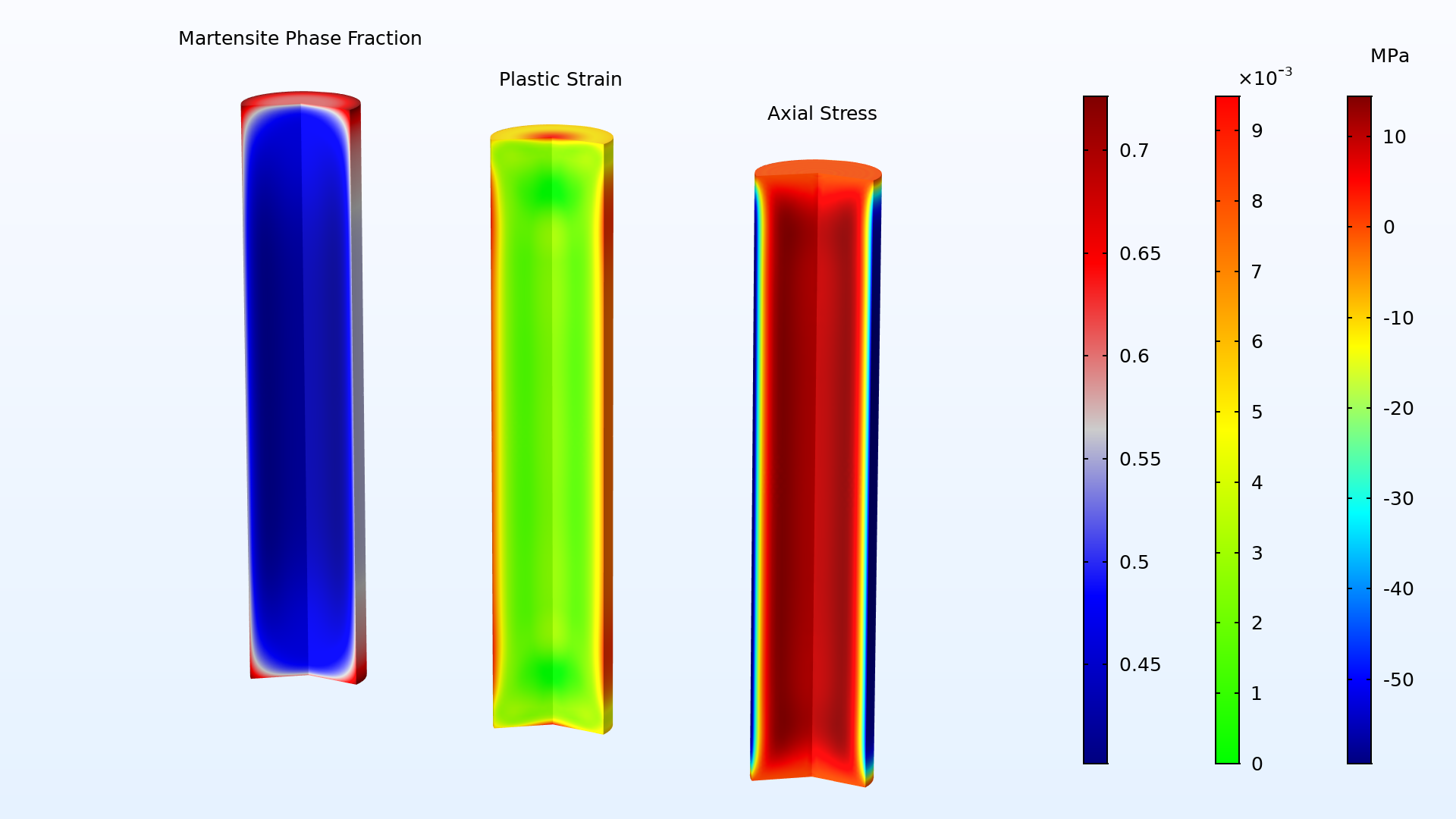
Steel quenching is a heat treatment process in which steel parts, heated to a fully austenitic state, are quenched. Being a multiphysics process, steel quenching involves a combination of austenite decomposition, heat transfer, and structural analysis. With the Steel Quenching multiphysics interface in the Metal Processing Module, several features are added automatically to facilitate the model setup. The interface prompts you to enter settings for the austenite, ferrite, pearlite, bainite, and martensite phases as well as the phase transformations from austenite to each of the others. Multiphysics couplings are also set up to account for the effects of latent heat and phase transformation strains.
Additionally, material properties for structural analysis can be temperature dependent and the plastic dissipation can act as a heat source in the heat transfer analysis. After running the analysis, you can examine phase compositions as well as the influence of cooling rate on the final distortions and residual stresses during quenching of a component. With these results, you gain insight into the efficacy of a certain quenchant and how the physical geometry of a component affects the attainable phase composition in its interior.
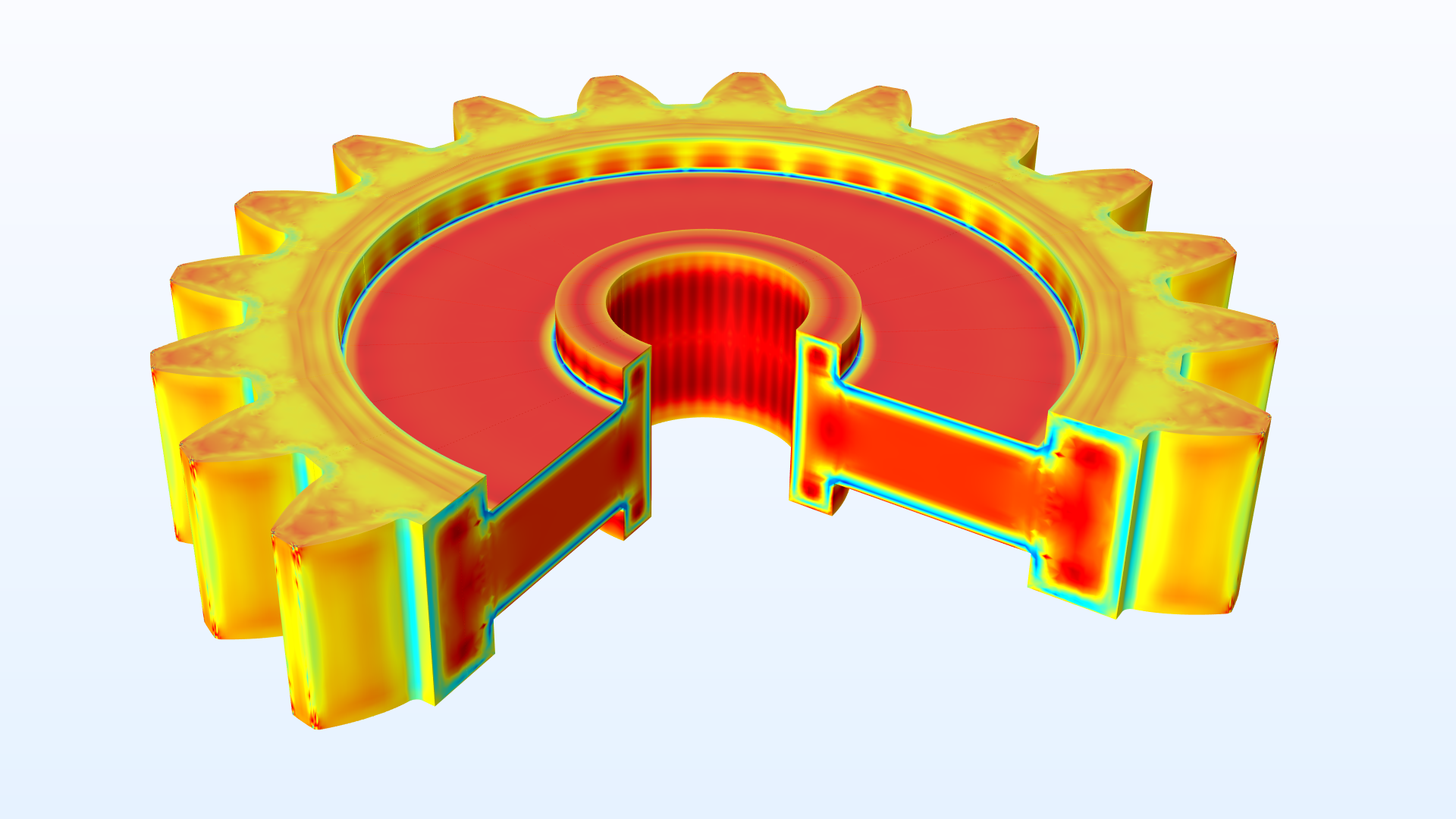
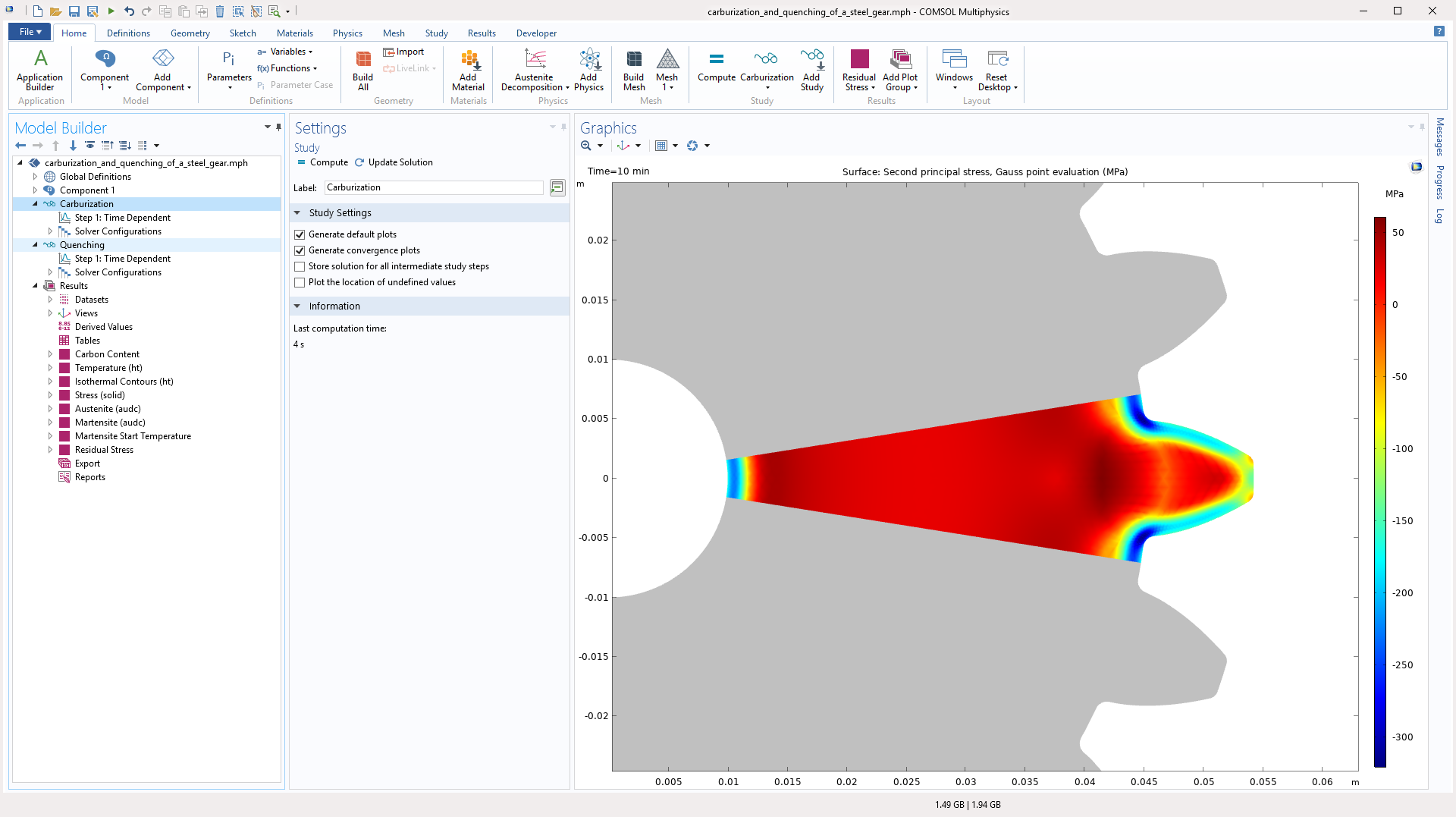
The process of carburisation involves heating a steel component and exposing it to a carbon-rich environment, such as carbon monoxide. Diffusion of carbon from the surrounding environment occurs through the boundary and into the material by means of a time-dependent diffusion process. You can model this process using the Carburisation interface and modify your phase transformation model data to depend on the calculated carbon content. Running carburisation analyses helps ensure that the process is carried out correctly; carburisation followed by quenching can produce compressive stresses at the surface of a component, which is beneficial from a fatigue standpoint.
In general, phase transformations occur while the material is subjected to a mechanical stress, resulting in transformation-induced plasticity (TRIP). An inelastic straining of the material results from stresses that are below the yield stress and would not cause plastic flow in a classical plasticity sense. The Metal Processing Module can be used to analyse the TRIP effect, for example, in the transformation from austenite to martensite.
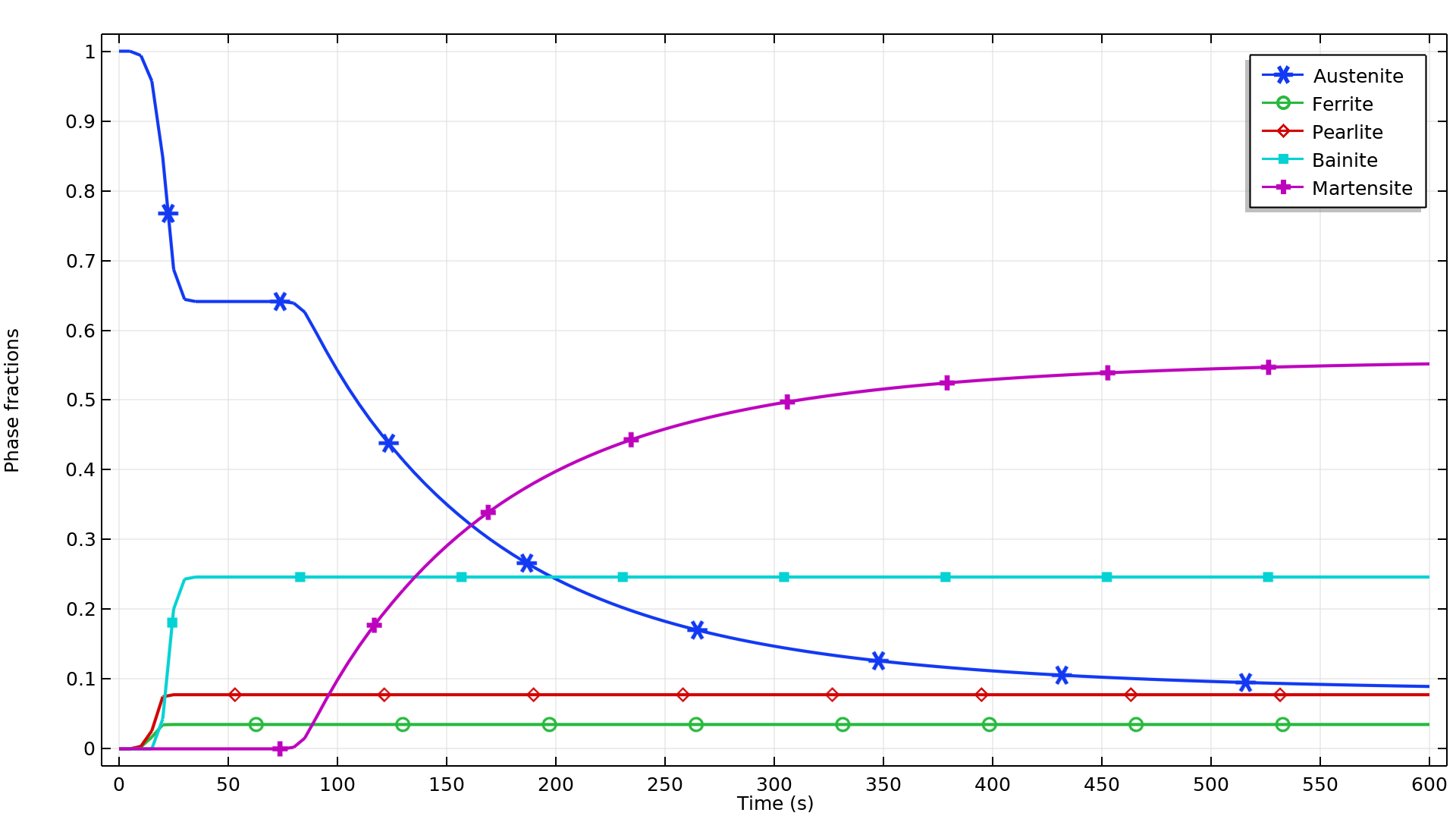
For diffusion-controlled phase transformations, such as when austenite decomposes into ferrite, two types of phase transformation models are provided: Leblond–Devaux and Johnson–Mehl–Avrami–Kolmogorov (JMAK). For modelling displacive (diffusionless) martensitic phase transformations, the Koistinen–Marburger model is available. These phase transformation models are available through the generalised Metal Phase Transformation interface that lets you define an arbitrary number of phases and phase transformations.
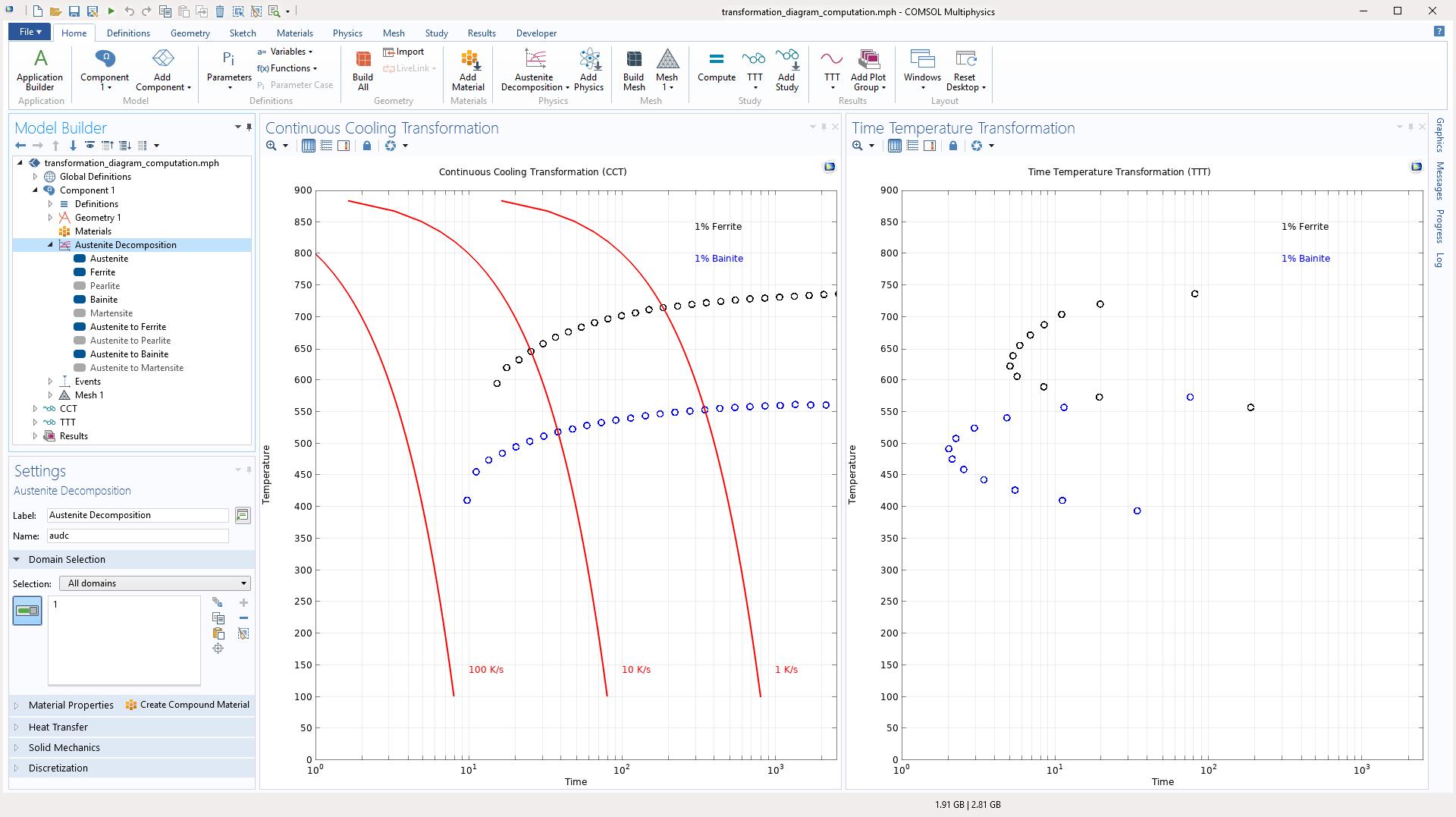
Additionally, it is possible to define your own phase transformation models to use in a simulation, and experimental calibration may be necessary for a given phase transformation. It is also possible to compute common phase transformation diagrams to facilitate calibration against experimental data, such as continuous cooling transformation (CCT) and time temperature transformation (TTT) diagrams.
Stresses and strains are computed using the effective material properties of the compound material, which are generally temperature and phase-composition dependent. The elastoplastic behaviour of the compound material is averaged across the individual phases. In the case where one phase is significantly harder than the others, a nonlinear weighting scheme can be used to model the effective initial yield stress of the compound material. There is a plastic recovery option for ensuring that phases appear gradually and devoid of prior plastic straining. The volume reference temperature and thermal expansion coefficient are used to compute a thermal strain tensor in each phase. The thermal strain tensors of the phases are averaged into a thermal strain of the compound material. For more advanced structural analyses, the Metal Processing Module can be combined with the Structural Mechanics Module.
The Metal Processing Module is equipped to model heat transport by using the full heat equation in the analysis. Additionally, the thermal conductivity, density, and specific heat capacity can be temperature dependent, and can even depend on the current phase composition. For example, the thermal conductivity of austenite is different from that of ferrite, and as the phase fractions evolve, so will the thermal conductivity of the compound material. For more advanced heat transfer analyses, the Metal Processing Module can be combined with the Heat Transfer Module.
 Tel: +61 (03) 6224 8690Email: info@technic.com.auConnect on LinkedInGet Your Free Trial