Vacuum engineers and scientists use the Molecular Flow Module to design vacuum systems and to understand and predict low-pressure gas flows. The use of simulation tools in the design cycle has become more widespread as these tools improve understanding, reduce prototyping costs, and speed up development. Vacuum systems are usually expensive to prototype. Therefore, an increased use of simulation in the design process can result in substantial cost savings. The gas flows that occur inside vacuum systems are described by different physics than conventional fluid flow problems. At low pressures, the mean free path of the gas molecules becomes comparable to the size of the system and gas rarefaction becomes important. Flow regimes are categorised quantitatively via the Knudsen number (Kn), which represents the ratio of the molecular mean free path to the flow geometry size for gases:
While the Microfluidics Module is used for modelling slip and continuum flows, the Molecular Flow Module is designed for accurately simulating flows in the free molecular flow regime. Historically, flows in this regime have been modelled by the direct simulation Monte Carlo (DSMC) method. This computes the trajectories of large numbers of randomised particles through the system, but introduces statistical noise into the modelling process. For low-velocity flows, such as those encountered in vacuum systems, the noise introduced by DSMC renders the simulations unfeasible.
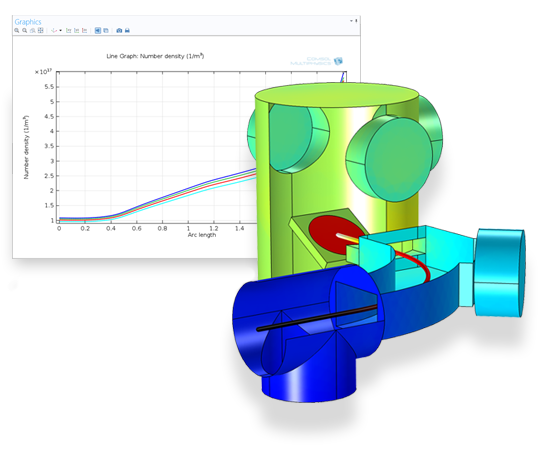
The Molecular Flow Module is designed to offer previously unavailable simulation capabilities for the accurate modelling of low-pressure gas flows in complex geometries. It is ideal for the simulation of vacuum systems, including those used in semiconductor processing, particle accelerators, and mass spectrometers. Small channel applications (e.g., shale gas exploration and flow in nanoporous materials) may also be addressed. The Molecular Flow Module uses the angular coefficient method to simulate steady-state free molecular flows, allowing the molecular flux, pressure, number density, and heat flux to be computed on surfaces. The number density can be reconstructed on domains, surfaces, edges, and points from the molecular flux on the surrounding surfaces. You can model isothermal and nonisothermal molecular flows and calculate the heat flux contribution from the gas molecules.
In an ion implanter, the average number density of outgassing molecules along the beam path is used as a figure of merit to evaluate the design. It must be computed as a function of wafer angle, with rotation about one axis.
 Tel: +61 (03) 6224 8690Email: info@technic.com.auConnect on LinkedInGet Your Free Trial
Copyright © 2021 Technic Pty Ltd. All Rights Reserved. See our Privacy Policy. Site protected by reCAPTCHA - Privacy | Terms. Website by Gloo.