The Multibody Dynamics Module is an add-on to the COMSOL Multiphysics software that provides an advanced set of tools for designing and optimising multibody structural mechanics systems using finite element analysis (FEA). The module enables you to simulate mixed systems of flexible and rigid bodies, where each body may be subjected to large rotational or translational displacements. Such analyses help identify critical points in your multibody systems, thus enabling you to perform more detailed component-level structural analyses. The Multibody Dynamics Module also gives you the freedom to analyse forces experienced by segments of the structure, and stresses generated in flexible components that may lead to failure due to large deformation or fatigue.
A library of predefined joints is included in the module so that you can easily and robustly specify the relationships between different components of a multibody system, where the components are interconnected such that only a certain type of motion is allowed between them. Joints connect two components through attachments, where one component moves independently in space while the other is constrained to follow a particular motion, depending on the joint type. The joint types in the Multibody Dynamics Module are generic to the extent that they can model any type of connection. Researchers and engineers can thereby design accurate multibody structural mechanics models, using the following joint types:
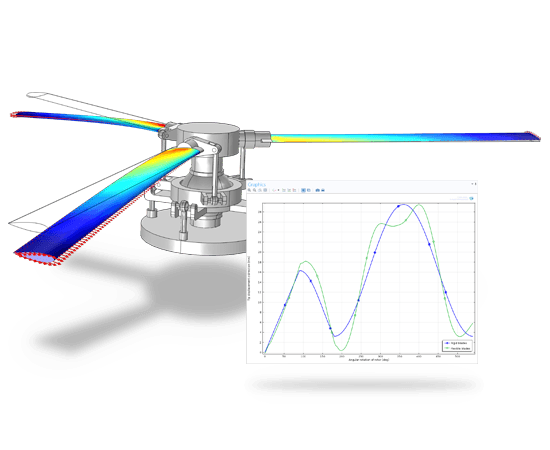
Components of a system that undergo deformations can be modelled as flexible, while other components, or even parts of these components, can be specified as rigid. You can also provide your multibody dynamics design and analyses with nonlinear material properties by combining models in the Multibody Dynamics Module with either the Nonlinear Structural Materials Module or the Geomechanics Module. At the same time, the rest of the physics that you can model with COMSOL Multiphysics and the suite of application-specific modules, can be coupled to the physics described by the Multibody Dynamics Module, such as the effects of heat transfer or electrical phenomena.
Transient, frequency-domain, eigenfrequency, and stationary multibody dynamics analyses can be performed. Joints can be assigned linear/torsional springs with damping properties, applied forces and moments, and prescribed motion as a function of time. Analysis and postprocessing capabilities include:
Often, motion between two components is restricted due to the presence or functions of other physical objects. Limiting and conditionally locking the relative motion can be specified for the joints in order to fully define and model these complex systems. In robotics, for example, the relative motion between two arms can be defined as a pre-defined function of time. Joints can also be spring-loaded and appropriate damping factors can be included in the Multibody Dynamics Module.
 Tel: +61 (03) 6224 8690Email: info@technic.com.auConnect on LinkedInGet Your Free Trial
Copyright © 2021 Technic Pty Ltd. All Rights Reserved. See our Privacy Policy. Site protected by reCAPTCHA - Privacy | Terms. Website by Gloo.