The Semiconductor Module provides dedicated tools for the analysis of semiconductor device operation at the fundamental physics level. The module is based on the drift-diffusion equations, using isothermal or nonisothermal transport models. It is useful for simulating a range of practical devices, including bipolar transistors, metal-semiconductor field-effect transistors (MESFETs), metal-oxide-semiconductor field-effect transistors (MOSFETs), insulated-gate bipolar transistors (IGBTs), Schottky diodes, and P-N junctions. A predefined Schrödinger Equation interface allows the modelling of quantum-confined systems such as quantum wells, wires, and dots.
Multiphysics effects often play important roles in semiconductor device performance. The Semiconductor Module enables you to easily create models involving multiple physical effects. For example, thermal effects within a power device can be simulated by adding a heat transfer physics interface (available in the COMSOL Multiphysics® software platform). Optical transitions can also be incorporated to simulate a range of devices such as solar cells, light-emitting diodes (LEDs), and photodiodes (some may require the Wave Optics Module).
You can choose to make use of the finite element or finite volume method when modelling the transport of holes and electrons in the Semiconductor Module. Each method has its set of advantages and disadvantages:
Transistor operation where an applied gate voltage turns the device on and then determines the drain saturation current.
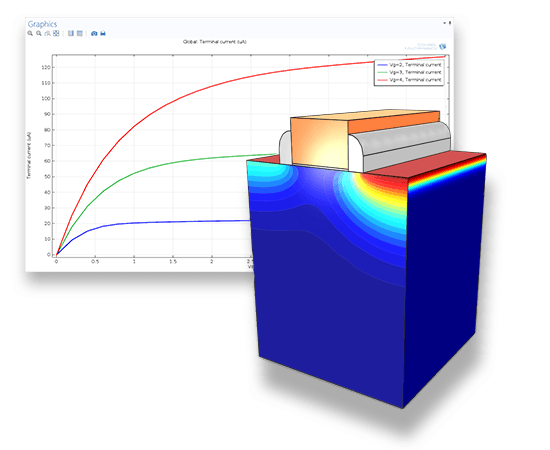
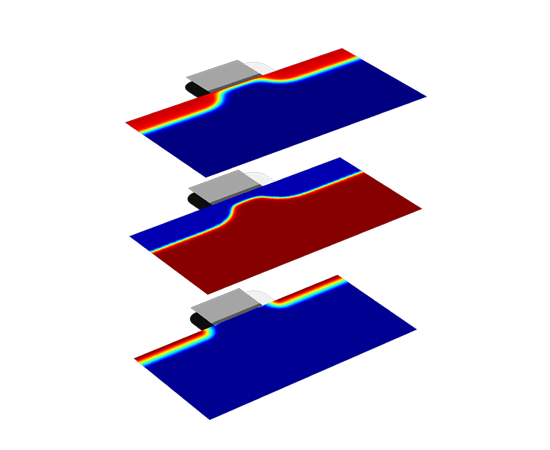
The Semiconductor Module is used for modelling semiconductor devices with the conventional drift-diffusion approach, the density-gradient formulation, the Schrodinger equation, or the Schrodinger-Poisson equation. Within the product, there is a number of physics interfaces – tools for receiving model inputs to describe a set of physical equations and boundary conditions. These include interfaces for modelling the transport of electrons and holes in semiconductor devices, the electrostatic behaviour of such, and an interface for coupling semiconductor simulations to a SPICE circuit simulation.
The Semiconductor interface solves Poisson’s equation in conjunction with the continuity equations for the charge carriers. It solves for both the electron and hole concentrations explicitly. You can choose between solving your model with the finite volume method or the finite element method. The Semiconductor interface includes material models for semiconducting and insulating materials, in addition to boundary conditions for ohmic contacts, Schottky contacts, gates, and a wide range of electrostatics boundary conditions.
Features within the Semiconductor interface describe the mobility property as it is limited by the scattering of carriers within the material. The Semiconductor Module includes several predefined mobility models and the option to create custom, user-defined mobility models. Both these types of models can be combined in arbitrary ways. Each mobility model defines an output electron and hole mobility. The output mobility can be used as an input to other mobility models, while equations can be used to combine mobilities, for example using Matthiessen's rule. The Semiconductor interface also contains features to add Auger, Direct, and Shockley-Read Hall recombination to a semiconducting domain, or you can specify your own recombination rate.
Specifying the doping distribution is critical for the modelling of semiconductor devices. The Semiconductor Module provides a Doping model feature to do this. Constant and user-defined doping profiles can be specified, or an approximate Gaussian doping profile can be used. It is also straightforward to import data from external sources into COMSOL Multiphysics®, which can be treated by built-in interpolation functions.
Along with the Semiconductor interface, the Semiconductor Module comes prepared with enhanced Electrostatics capabilities, available both within the Semiconductor interface and in a standalone Electrostatics interface. System level and mixed device simulations are enabled through a physics interface for electrical circuits with SPICE import capability. When combined with the Wave Optics Module or the RF Module, additional physics interfaces are made available for Optoelectronics simulations. The Semiconductor Module includes an additional material database with properties for several materials. Each model comes with documentation that includes a theoretical background and step-by-step instructions on how to create the model. The models are available in COMSOL as MPH-files that you can open for further investigation. You can use the step-by-step instructions and the actual models as a template for your own modelling and applications.
 Tel: +61 (03) 6224 8690Email: info@technic.com.auConnect on LinkedInGet Your Free Trial
Copyright © 2021 Technic Pty Ltd. All Rights Reserved. See our Privacy Policy. Site protected by reCAPTCHA - Privacy | Terms. Website by Gloo.